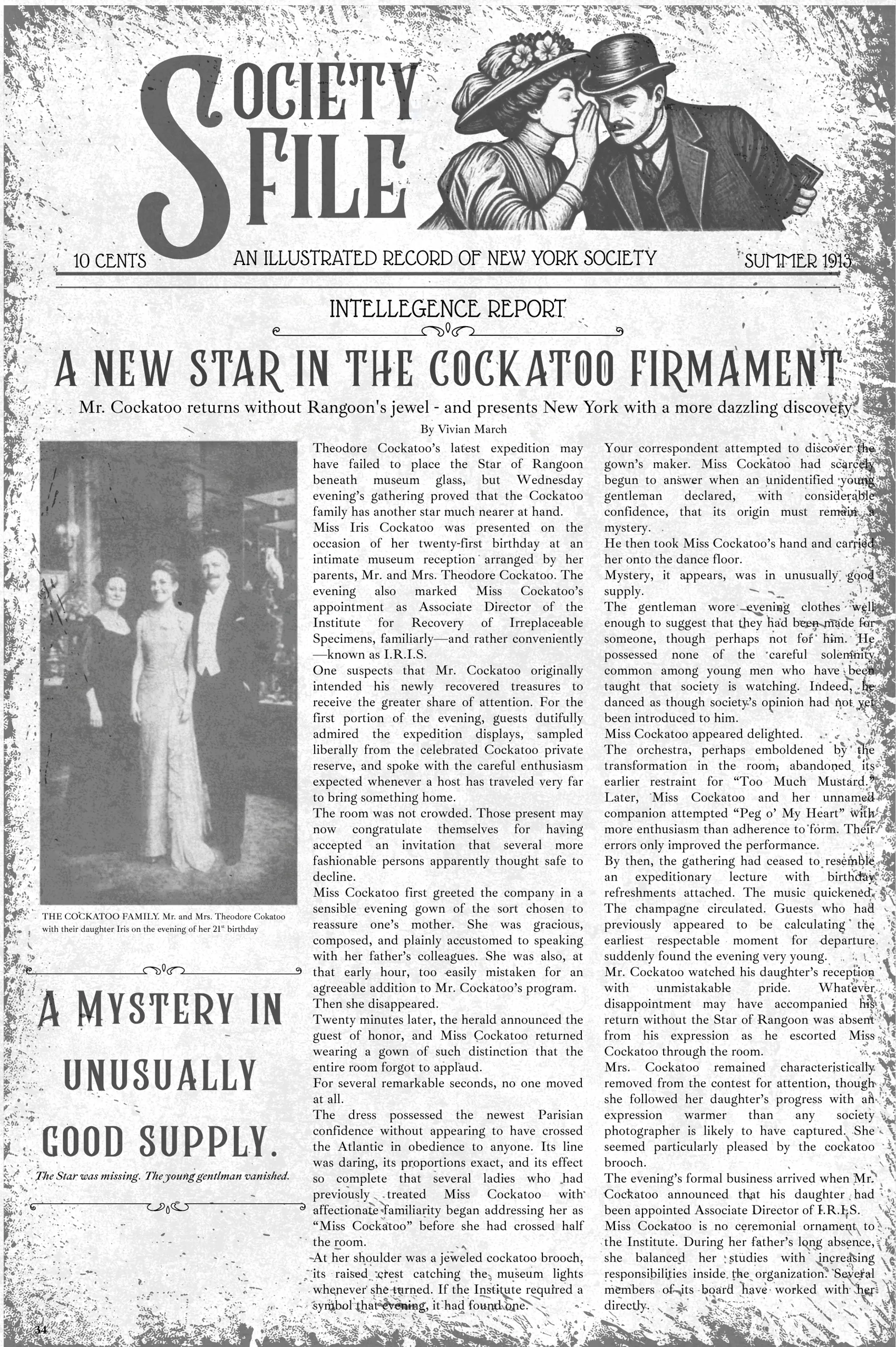
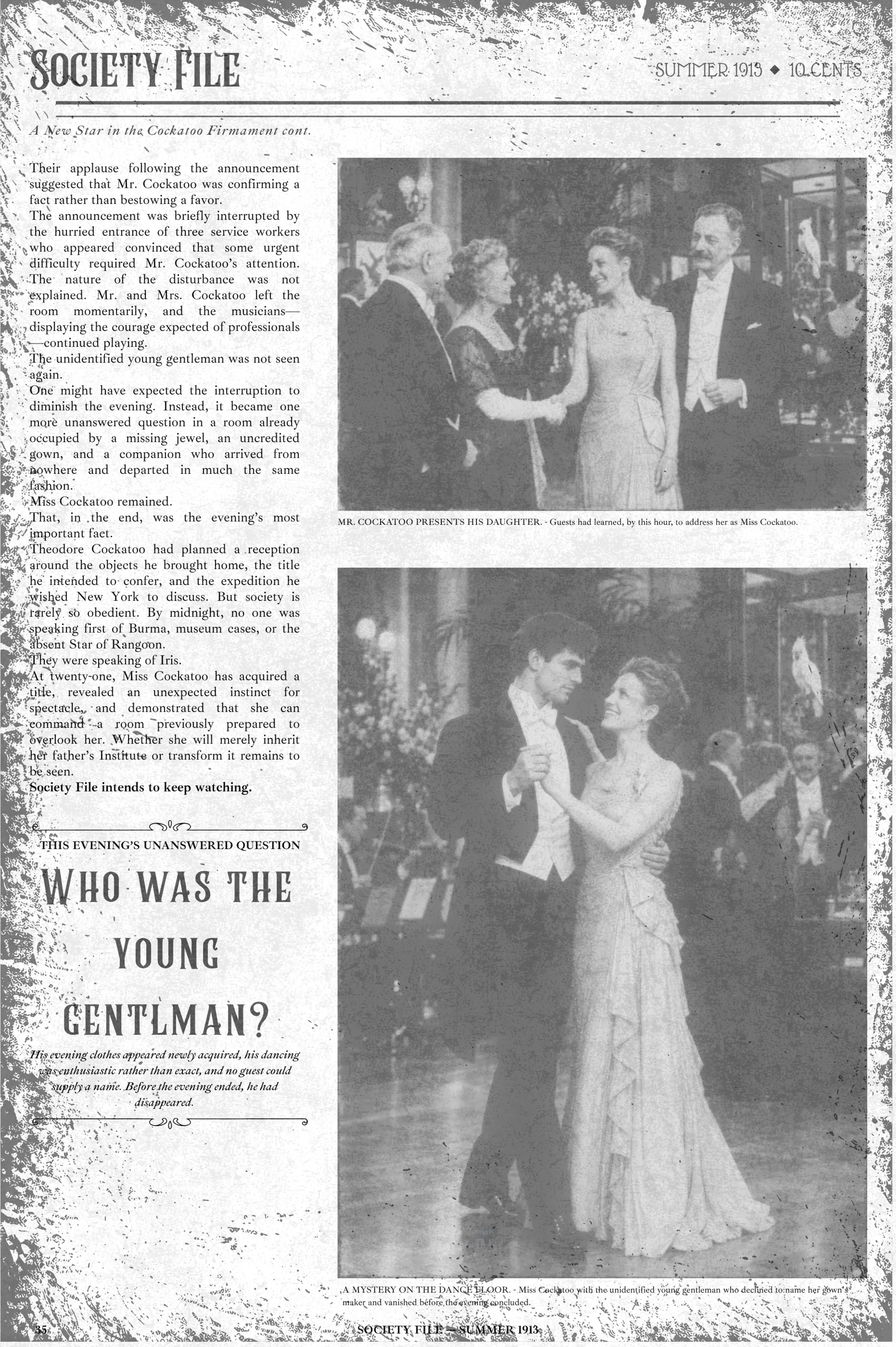
A New Star in the Cockatoo Firmament, by Vivian March. Society File, Summer 1913, pages 34–35.
First page of Vivian March’s Society File account of Iris Cockatoo’s twenty-first birthday gala, Summer 1913.
Accession number
Not recorded
Record type
Publication
Date as recorded
Summer 1913 (issue)
Place as recorded
Not recorded
Byline or attribution
Vivian March · Society File
Expedition or collection
Not recorded
Medium or format
Two illustrated magazine pages
Vivian March’s two-page Society File account of Iris Cockatoo’s twenty-first birthday gala records her public reception and appointment as Associate Director. The young gentleman who joins her on the dance floor remains unnamed in the article.
The complete article
Page 1 of 2 · Select the page to read at full size.Page 2 of 2 · Select the page to read at full size.
Custody and provenance
Archive notes
Uncertain or missing information
The article does not name Iris Cockatoo’s dance partner or explain the disturbance. It records the public account of the evening.
Transcript
PAGE 1 · SOCIETY FILE · SUMMER 1913 · 10 CENTS
AN ILLUSTRATED RECORD OF NEW YORK SOCIETY
INTELLEGENCE REPORT
A NEW STAR IN THE COCKATOO FIRMAMENT
Mr. Cockatoo returns without Rangoon’s jewel – and presents New York with a more dazzling discovery.
By Vivian March
Theodore Cockatoo’s latest expedition may have failed to place the Star of Rangoon beneath museum glass, but Wednesday evening’s gathering proved that the Cockatoo family has another star much nearer at hand.
Miss Iris Cockatoo was presented on the occasion of her twenty-first birthday at an intimate museum reception arranged by her parents, Mr. and Mrs. Theodore Cockatoo. The evening also marked Miss Cockatoo’s appointment as Associate Director of the Institute for Recovery of Irreplaceable Specimens, familiarly—and rather conveniently—known as I.R.I.S.
One suspects that Mr. Cockatoo originally intended his newly recovered treasures to receive the greater share of attention. For the first portion of the evening, guests dutifully admired the expedition displays, sampled liberally from the celebrated Cockatoo private reserve, and spoke with the careful enthusiasm expected whenever a host has traveled very far to bring something home.
The room was not crowded. Those present may now congratulate themselves for having accepted an invitation that several more fashionable persons apparently thought safe to decline.
Miss Cockatoo first greeted the company in a sensible evening gown of the sort chosen to reassure one’s mother. She was gracious, composed, and plainly accustomed to speaking with her father’s colleagues. She was also, at that early hour, too easily mistaken for an agreeable addition to Mr. Cockatoo’s program.
Then she disappeared.
Twenty minutes later, the herald announced the guest of honor, and Miss Cockatoo returned wearing a gown of such distinction that the entire room forgot to applaud.
For several remarkable seconds, no one moved at all.
The dress possessed the newest Parisian confidence without appearing to have crossed the Atlantic in obedience to anyone. Its line was daring, its proportions exact, and its effect so complete that several ladies who had previously treated Miss Cockatoo with affectionate familiarity began addressing her as “Miss Cockatoo” before she had crossed half the room.
At her shoulder was a jeweled cockatoo brooch, its raised crest catching the museum lights whenever she turned. If the Institute required a symbol that evening, it had found one.
Your correspondent attempted to discover the gown’s maker. Miss Cockatoo had scarcely begun to answer when an unidentified young gentleman declared, with considerable confidence, that its origin must remain a mystery.
He then took Miss Cockatoo’s hand and carried her onto the dance floor.
Mystery, it appears, was in unusually good supply.
The gentleman wore evening clothes well enough to suggest that they had been made for someone, though perhaps not for him. He possessed none of the careful solemnity common among young men who have been taught that society is watching. Indeed, he danced as though society’s opinion had not yet been introduced to him.
Miss Cockatoo appeared delighted.
The orchestra, perhaps emboldened by the transformation in the room, abandoned its earlier restraint for “Too Much Mustard.” Later, Miss Cockatoo and her unnamed companion attempted “Peg o’ My Heart” with more enthusiasm than adherence to form. Their errors only improved the performance.
By then, the gathering had ceased to resemble an expeditionary lecture with birthday refreshments attached. The music quickened. The champagne circulated. Guests who had previously appeared to be calculating the earliest respectable moment for departure suddenly found the evening very young.
Mr. Cockatoo watched his daughter’s reception with unmistakable pride. Whatever disappointment may have accompanied his return without the Star of Rangoon was absent from his expression as he escorted Miss Cockatoo through the room.
Mrs. Cockatoo remained characteristically removed from the contest for attention, though she followed her daughter’s progress with an expression warmer than any society photographer is likely to have captured. She seemed particularly pleased by the cockatoo brooch.
The evening’s formal business arrived when Mr. Cockatoo announced that his daughter had been appointed Associate Director of I.R.I.S.
Miss Cockatoo is no ceremonial ornament to the Institute. During her father’s long absence, she balanced her studies with increasing responsibilities inside the organization. Several members of its board have worked with her directly.
Photograph caption: THE COCKATOO FAMILY. Mr. and Mrs. Theodore Cokatoo with their daughter Iris on the evening of her 21st birthday.
Pull quote: A MYSTERY IN UNUSUALLY GOOD SUPPLY.
The Star was missing. The young gentleman vanished.
Page 34.
PAGE 2 · SOCIETY FILE · SUMMER 1913 · 10 CENTS
A New Star in the Cockatoo Firmament cont.
Their applause following the announcement suggested that Mr. Cockatoo was confirming a fact rather than bestowing a favor.
The announcement was briefly interrupted by the hurried entrance of three service workers who appeared convinced that some urgent difficulty required Mr. Cockatoo’s attention. The nature of the disturbance was not explained. Mr. and Mrs. Cockatoo left the room momentarily, and the musicians—displaying the courage expected of professionals—continued playing.
The unidentified young gentleman was not seen again.
One might have expected the interruption to diminish the evening. Instead, it became one more unanswered question in a room already occupied by a missing jewel, an uncredited gown, and a companion who arrived from nowhere and departed in much the same fashion.
Miss Cockatoo remained.
That, in the end, was the evening’s most important fact.
Theodore Cockatoo had planned a reception around the objects he brought home, the title he intended to confer, and the expedition he wished New York to discuss. But society is rarely so obedient. By midnight, no one was speaking first of Burma, museum cases, or the absent Star of Rangoon.
They were speaking of Iris.
At twenty-one, Miss Cockatoo has acquired a title, revealed an unexpected instinct for spectacle, and demonstrated that she can command a room previously prepared to overlook her. Whether she will merely inherit her father’s Institute or transform it remains to be seen.
Society File intends to keep watching.
Photograph caption: MR. COCKATOO PRESENTS HIS DAUGHTER. – Guests had learned, by this hour, to address her as Miss Cockatoo.
THIS EVENING’S UNANSWERED QUESTION
WHO WAS THE YOUNG GENTLEMAN?
His evening clothes appeared newly acquired, his dancing was enthusiastic rather than exact, and no guest could supply a name. Before the evening ended, he had disappeared.
Photograph caption: A MYSTERY ON THE DANCE FLOOR. – Miss Cockatoo with the unidentified young gentleman who declined to name her gown’s maker and vanished before the evening concluded.
Page 35 · SOCIETY FILE · SUMMER 1913