Vivian March’s June 1937 Society File report covers the Lion Rock Chamber opening, the public ceremony and the aftermath of a collapse.
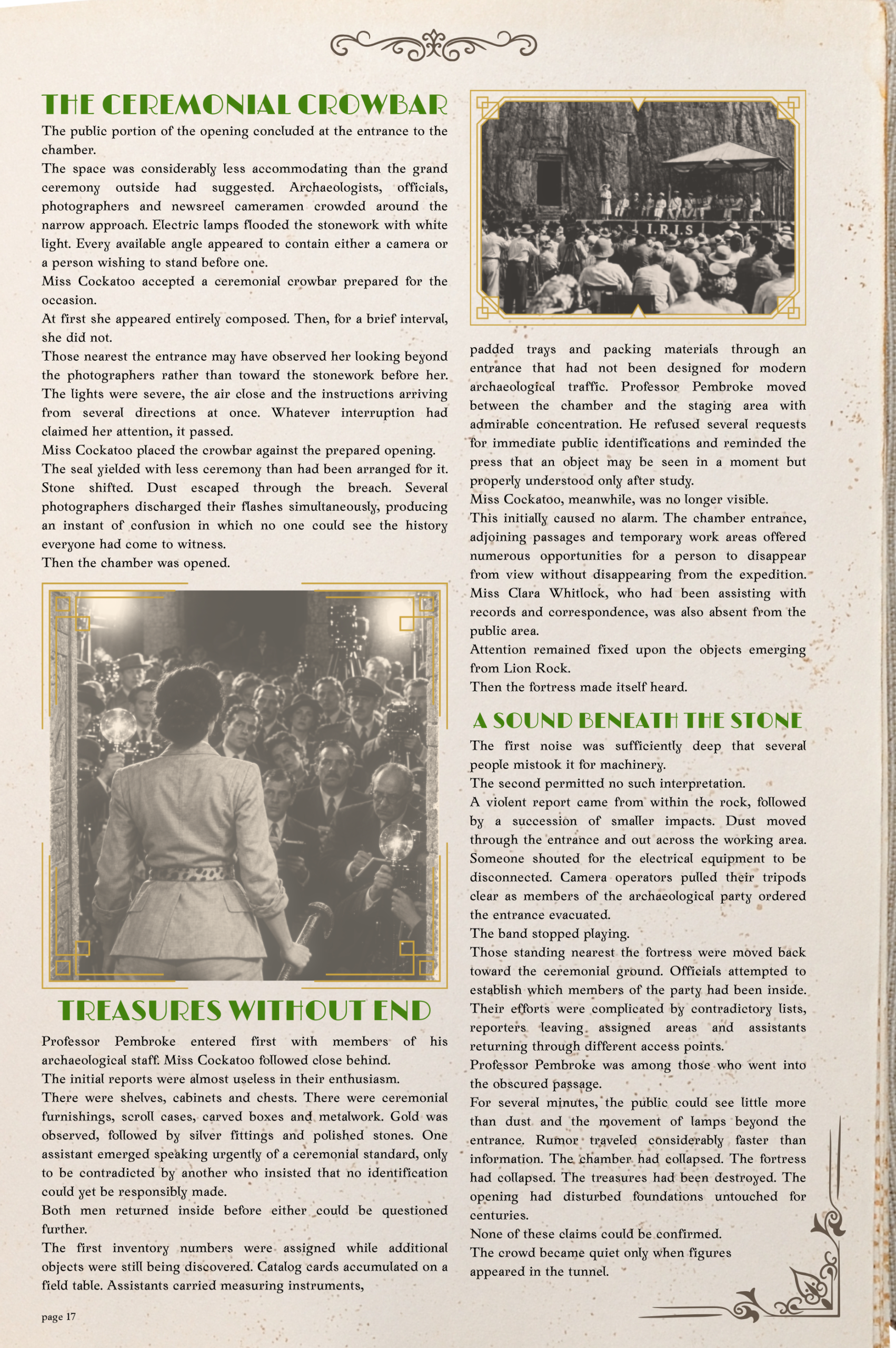
First page of Vivian March’s Society File report, pages 16–18.
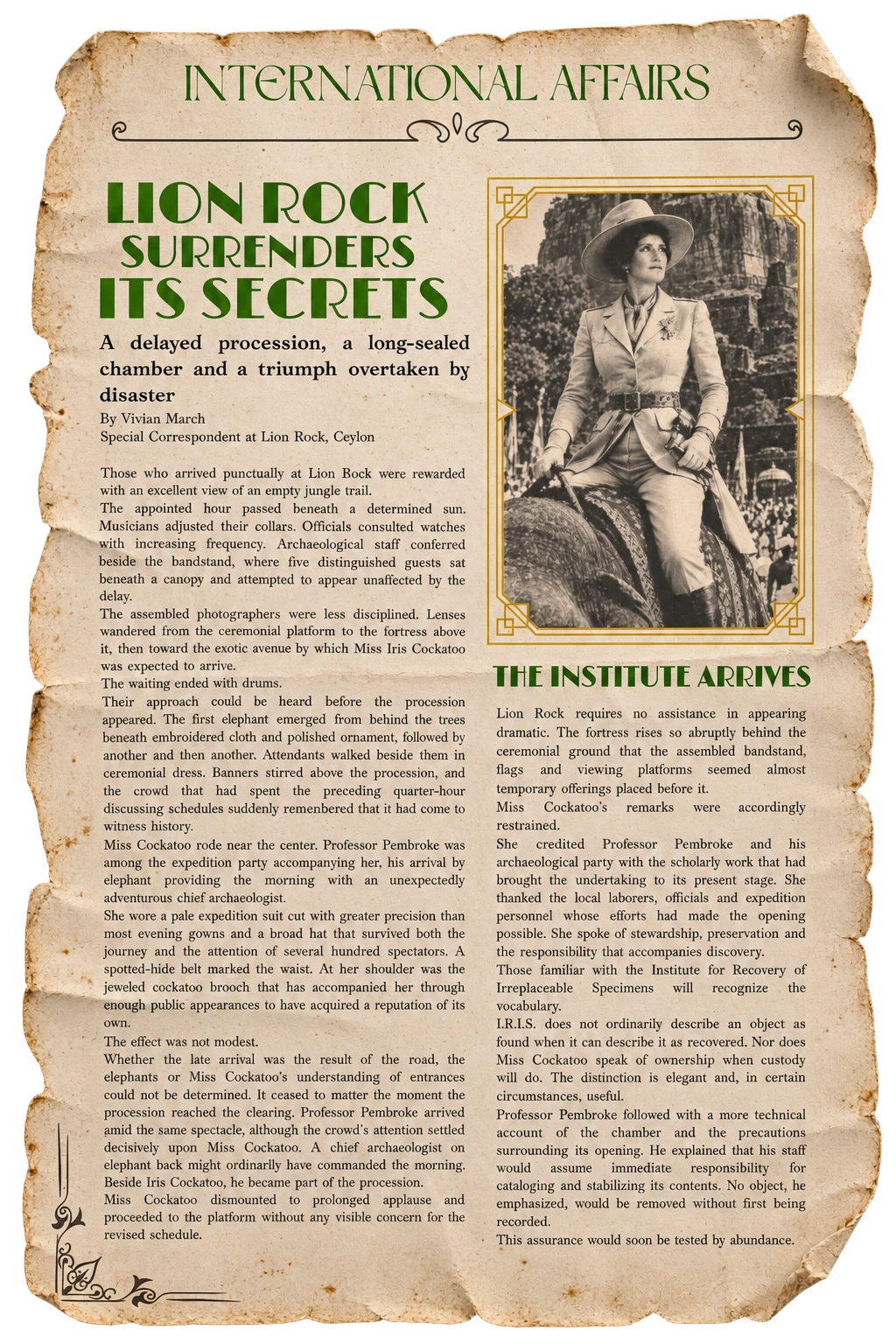
Society File article headed Lion Rock Surrenders Its Secrets, with Vivian March’s byline and a photograph of Iris at Lion Rock.
Accession number
Not recorded
Record type
Illustrated article
Date as recorded
June 1937
Place as recorded
Lion Rock, Ceylon
Byline or attribution
Vivian March
Expedition or collection
Pop Culture — Society Gossip
Medium or format
Not recorded
Vivian March’s illustrated report of the Lion Rock Chamber opening appeared in the June 1937 Society File. March also wrote A Murder in May, an account of the Carinthia crossing. Her article describes the public ceremony, the chamber opening and the aftermath of a collapse.
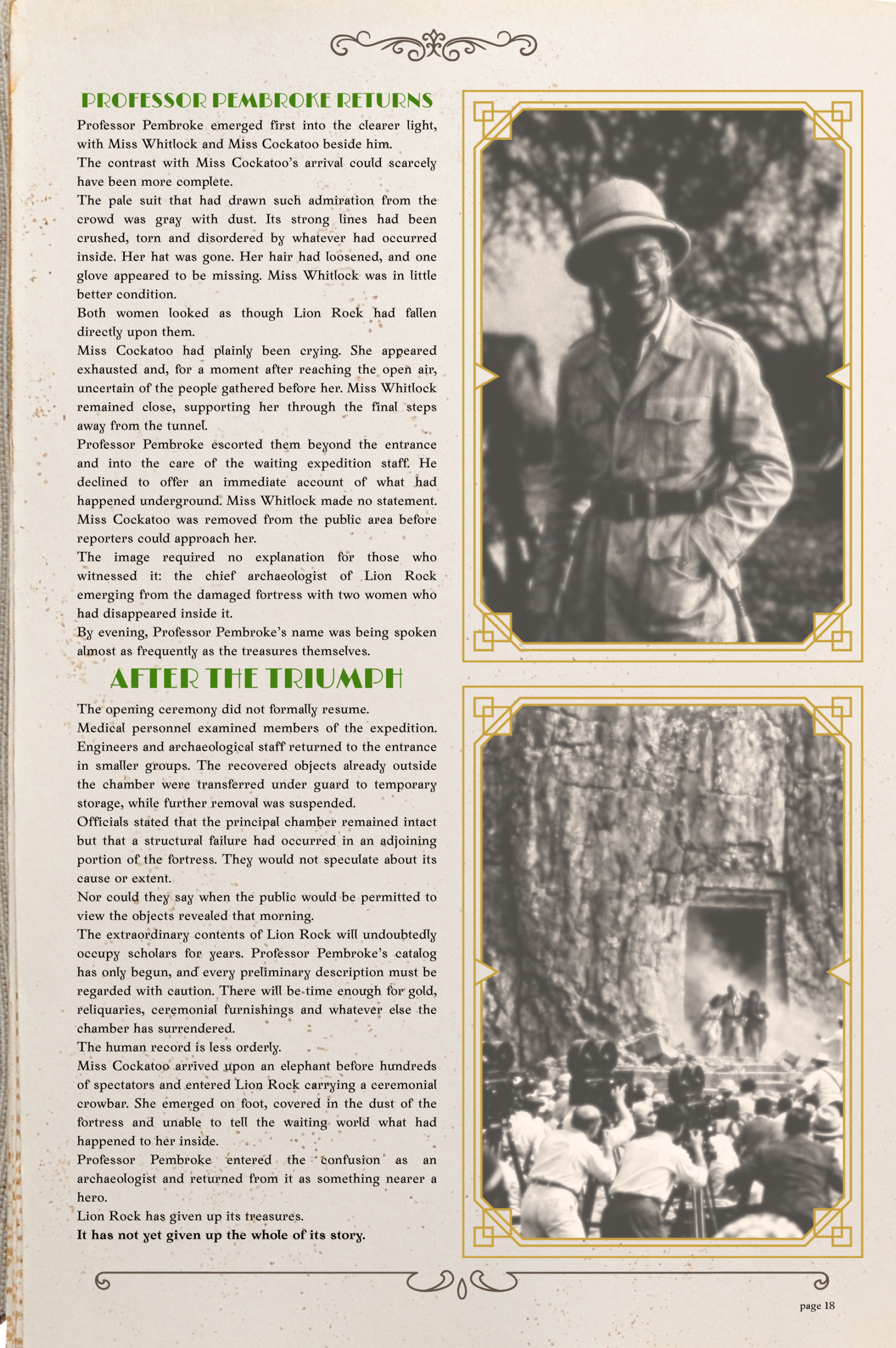
Society File, June 1937, page 17.Society File, June 1937, page 18.
Custody and provenance
Archive notes
Uncertain or missing information
Transcript
Page 16
INTERNATIONAL AFFAIRS
LION ROCK SURRENDERS ITS SECRETS
A delayed procession, a long-sealed chamber and a triumph overtaken by disaster
By Vivian March
Special Correspondent at Lion Rock, Ceylon
Those who arrived punctually at Lion Rock were rewarded with an excellent view of an empty jungle trail.
The appointed hour passed beneath a determined sun. Musicians adjusted their collars. Officials consulted watches with increasing frequency. Archaeological staff conferred beside the bandstand, where five distinguished guests sat beneath a canopy and attempted to appear unaffected by the delay.
The assembled photographers were less disciplined. Lenses wandered from the ceremonial platform to the fortress above it, then toward the exotic avenue by which Miss Iris Cockatoo was expected to arrive.
The waiting ended with drums.
Their approach could be heard before the procession appeared. The first elephant emerged from behind the trees beneath embroidered cloth and polished ornament, followed by another and then another. Attendants walked beside them in ceremonial dress. Banners stirred above the procession, and the crowd that had spent the preceding quarter-hour discussing schedules suddenly remembered that it had come to witness history.
Miss Cockatoo rode near the center. Professor Pembroke was among the expedition party accompanying her, his arrival by elephant providing the morning with an unexpectedly adventurous chief archaeologist.
She wore a pale expedition suit cut with greater precision than most evening gowns and a broad hat that survived both the journey and the attention of several hundred spectators. A spotted-hide belt marked the waist. At her shoulder was the jeweled cockatoo brooch that has accompanied her through enough public appearances to have acquired a reputation of its own.
The effect was not modest.
Whether the late arrival was the result of the road, the elephants or Miss Cockatoo’s understanding of entrances could not be determined. It ceased to matter the moment the procession reached the clearing. Professor Pembroke arrived amid the same spectacle, although the crowd’s attention settled decisively upon Miss Cockatoo. A chief archaeologist on elephant back might ordinarily have commanded the morning. Beside Iris Cockatoo, he became part of the procession.
Miss Cockatoo dismounted to prolonged applause and proceeded to the platform without any visible concern for the revised schedule.
THE INSTITUTE ARRIVES
Lion Rock requires no assistance in appearing dramatic. The fortress rises so abruptly behind the ceremonial ground that the assembled bandstand, flags and viewing platforms seemed almost temporary offerings placed before it.
Miss Cockatoo’s remarks were accordingly restrained.
She credited Professor Pembroke and his archaeological party with the scholarly work that had brought the undertaking to its present stage. She thanked the local laborers, officials and expedition personnel whose efforts had made the opening possible. She spoke of stewardship, preservation and the responsibility that accompanies discovery.
Those familiar with the Institute for Recovery of Irreplaceable Specimens will recognize the vocabulary.
I.R.I.S. does not ordinarily describe an object as found when it can describe it as recovered. Nor does Miss Cockatoo speak of ownership when custody will do. The distinction is elegant and, in certain circumstances, useful.
Professor Pembroke followed with a more technical account of the chamber and the precautions surrounding its opening. He explained that his staff would assume immediate responsibility for cataloging and stabilizing its contents. No object, he emphasized, would be removed without first being recorded.
This assurance would soon be tested by abundance.
Page 17
THE CEREMONIAL CROWBAR
The public portion of the opening concluded at the entrance to the chamber.
The space was considerably less accommodating than the grand ceremony outside had suggested. Archaeologists, officials, photographers and newsreel cameramen crowded around the narrow approach. Electric lamps flooded the stonework with white light. Every available angle appeared to contain either a camera or a person wishing to stand before one.
Miss Cockatoo accepted a ceremonial crowbar prepared for the occasion.
At first she appeared entirely composed. Then, for a brief interval, she did not.
Those nearest the entrance may have observed her looking beyond the photographers rather than toward the stonework before her. The lights were severe, the air close and the instructions arriving from several directions at once. Whatever interruption had claimed her attention, it passed.
Miss Cockatoo placed the crowbar against the prepared opening.
The seal yielded with less ceremony than had been arranged for it. Stone shifted. Dust escaped through the breach. Several photographers discharged their flashes simultaneously, producing an instant of confusion in which no one could see the history everyone had come to witness.
Then the chamber was opened.
TREASURES WITHOUT END
Professor Pembroke entered first with members of his archaeological staff. Miss Cockatoo followed close behind.
The initial reports were almost useless in their enthusiasm.
There were shelves, cabinets and chests. There were ceremonial furnishings, scroll cases, carved boxes and metalwork. Gold was observed, followed by silver fittings and polished stones. One assistant emerged speaking urgently of a ceremonial standard, only to be contradicted by another who insisted that no identification could yet be responsibly made.
Both men returned inside before either could be questioned further.
The first inventory numbers were assigned while additional objects were still being discovered. Catalog cards accumulated on a field table. Assistants carried measuring instruments, padded trays and packing materials through an entrance that had not been designed for modern archaeological traffic. Professor Pembroke moved between the chamber and the staging area with admirable concentration. He refused several requests for immediate public identifications and reminded the press that an object may be seen in a moment but properly understood only after study.
Miss Cockatoo, meanwhile, was no longer visible.
This initially caused no alarm. The chamber entrance, adjoining passages and temporary work areas offered numerous opportunities for a person to disappear from view without disappearing from the expedition.
Miss Clara Whitlock, who had been assisting with records and correspondence, was also absent from the public area.
Attention remained fixed upon the objects emerging from Lion Rock.
Then the fortress made itself heard.
A SOUND BENEATH THE STONE
The first noise was sufficiently deep that several people mistook it for machinery.
The second permitted no such interpretation.
A violent report came from within the rock, followed by a succession of smaller impacts. Dust moved through the entrance and out across the working area. Someone shouted for the electrical equipment to be disconnected. Camera operators pulled their tripods clear as members of the archaeological party ordered the entrance evacuated.
The band stopped playing.
Those standing nearest the fortress were moved back toward the ceremonial ground. Officials attempted to establish which members of the party had been inside. Their efforts were complicated by contradictory lists, reporters leaving assigned areas and assistants returning through different access points.
Professor Pembroke was among those who went into the obscured passage.
For several minutes, the public could see little more than dust and the movement of lamps beyond the entrance. Rumor traveled considerably faster than information. The chamber had collapsed. The fortress had collapsed. The treasures had been destroyed. The opening had disturbed foundations untouched for centuries.
None of these claims could be confirmed.
The crowd became quiet only when figures appeared in the tunnel.
Page 18
PROFESSOR PEMBROKE RETURNS
Professor Pembroke emerged first into the clearer light, with Miss Whitlock and Miss Cockatoo beside him.
The contrast with Miss Cockatoo’s arrival could scarcely have been more complete.
The pale suit that had drawn such admiration from the crowd was gray with dust. Its strong lines had been crushed, torn and disordered by whatever had occurred inside. Her hat was gone. Her hair had loosened, and one glove appeared to be missing. Miss Whitlock was in little better condition.
Both women looked as though Lion Rock had fallen directly upon them.
Miss Cockatoo had plainly been crying. She appeared exhausted and, for a moment after reaching the open air, uncertain of the people gathered before her. Miss Whitlock remained close, supporting her through the final steps away from the tunnel.
Professor Pembroke escorted them beyond the entrance and into the care of the waiting expedition staff. He declined to offer an immediate account of what had happened underground. Miss Whitlock made no statement. Miss Cockatoo was removed from the public area before reporters could approach her.
The image required no explanation for those who witnessed it: the chief archaeologist of Lion Rock emerging from the damaged fortress with two women who had disappeared inside it.
By evening, Professor Pembroke’s name was being spoken almost as frequently as the treasures themselves.
AFTER THE TRIUMPH
The opening ceremony did not formally resume.
Medical personnel examined members of the expedition. Engineers and archaeological staff returned to the entrance in smaller groups. The recovered objects already outside the chamber were transferred under guard to temporary storage, while further removal was suspended.
Officials stated that the principal chamber remained intact but that a structural failure had occurred in an adjoining portion of the fortress. They would not speculate about its cause or extent.
Nor could they say when the public would be permitted to view the objects revealed that morning.
The extraordinary contents of Lion Rock will undoubtedly occupy scholars for years. Professor Pembroke’s catalog has only begun, and every preliminary description must be regarded with caution. There will be time enough for gold, reliquaries, ceremonial furnishings and whatever else the chamber has surrendered.
The human record is less orderly.
Miss Cockatoo arrived upon an elephant before hundreds of spectators and entered Lion Rock carrying a ceremonial crowbar. She emerged on foot, covered in the dust of the fortress and unable to tell the waiting world what had happened to her inside.
Professor Pembroke entered the confusion as an archaeologist and returned from it as something nearer a hero.
Lion Rock has given up its treasures.
It has not yet given up the whole of its story.